LEARN MORE
Read What Parents Want
READ
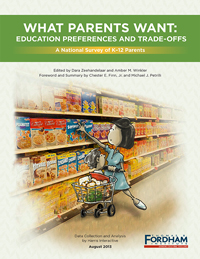
When it comes to what parents look for in schools for their children, they are alike in some ways and different in others—in their values, priorities, and preferences. A groundbreaking study by the Thomas B. Fordham Institute examines what educational goals and school attributes are important to all parents and what preferences are highly valued by some parents but not others. Are your preferences similar to most of America's parents? Or are there factors that are more important to you than they are to others?
Take this streamlined, six-question version of our market-research survey and find out!
Tell us about yourself

Highly rated student goal: Accepted at a top-tier college
Strivers are more likely to say that their child is naturally gifted and enjoys school and are more likely to expect that he or she will attain a graduate or professional degree. When it comes to other preferences, Strivers find non-college-related factors less important than do parents as a whole; they place lower significance on their child learning social skills, self-esteem, and a strong moral code of conduct. Strivers are more likely to be African American or Hispanic than the parent population. Compared to the population, their children are more likely to attend a charter school.

Highly rated school characteristic: Offers vocational classes or job-related programs—for example, information technology, medical technology, automotive
Pragmatists are less likely than others to expect their child to go beyond high school in their education, so it follows that they find it critical that schools help their child prepare for the work world. Compared to the population, it is less critical to them that their child’s school holds them to extremely high academic standards, and they place more importance on whether the school offers programs for students who struggle. They are a bit less satisfied with their child’s current school than K–12 parents as a whole. Pragmatists are more likely to be parents of boys and have a lower household income. Children of Pragmatists are not as academically strong as their peers and could face some learning challenges.

Highly rated school characteristic: Emphasizes instruction in citizenship, democracy, and leadership
Jeffersonians are quite similar to the total parent population. Even though they want schools to emphasize instruction in citizenship and leadership, Jeffersonians are no more likely than other parents to be active in their communities or schools. But compared to parents as a group, Jeffersonians find it more important that schools emphasize character development and ethics and that their child develops a strong moral code of conduct. In contrast, they see it as less critical that schools take a traditional approach to learning and prepare students for taking state tests.

Highly rated school characteristic: Has high test scores
Test-Score Hawks are more likely than other parents to say they have academically gifted children who put in more effort at school than average. They are more likely than other parents to say they set high expectations for their child and push them to excel (and are more likely to expect their child to receive a graduate degree). Hawks have high expectations for their schools, as a disproportionately large percentage say they enrolled their child in a different school because they were dissatisfied with the school or teachers. They find it more critical than the population that their child is prepared for college, and they care less about whether their child develops strong social skills. As a group, Hawks are a bit younger than the average parent and more likely to be African American or Hispanic.

Highly rated student goal: Learns how to work with people from diverse racial, ethnic, or socioeconomic backgrounds or cultures
Compared to the parent population, Multiculturalists are more likely to let their child develop at her own pace versus setting pushing her to excel. They find it less critical that their child is prepared for college and learns good study habits, but they find it more important that schools offer vocational classes or job-related programs. Multiculturalists are more likely to say that, compared to other students, their child performs "about average" in school. Multiculturalists are more likely to be African American and identify as politically liberal.

Highly rated school characteristic: Emphasizes arts and music instruction
Expressionists are more likely to say that they let their child develop at her own pace (vs. setting high expectations) and that they encourage their child to ask questions instead of setting firm rules. But they do not differ from the population when it comes to the high import they place on their child learning good study habits, critical thinking, and communication skills. They also rank preparation for college just as highly as the total population. Expressionists are more likely to be parents of girls and to identify as politically liberal. This group also has a disproportionately high percentage of charter school parents.

When asked to prioritize between a number of education goals for their children and the characteristics of the ideal school, here’s what came out on top:
Parents are more alike than they are different. Most parents prioritize a strong core curriculum in reading and math; an emphasis on science, technology, engineering, and math (STEM); and the development of good study habits, strong critical thinking skills, and excellent verbal and written communication skills. These preferences persist across parents of different races, household incomes, and political ideologies, and were consistently ranked highly by parents regardless of whether their child attends a traditional public, public charter, or private school.


